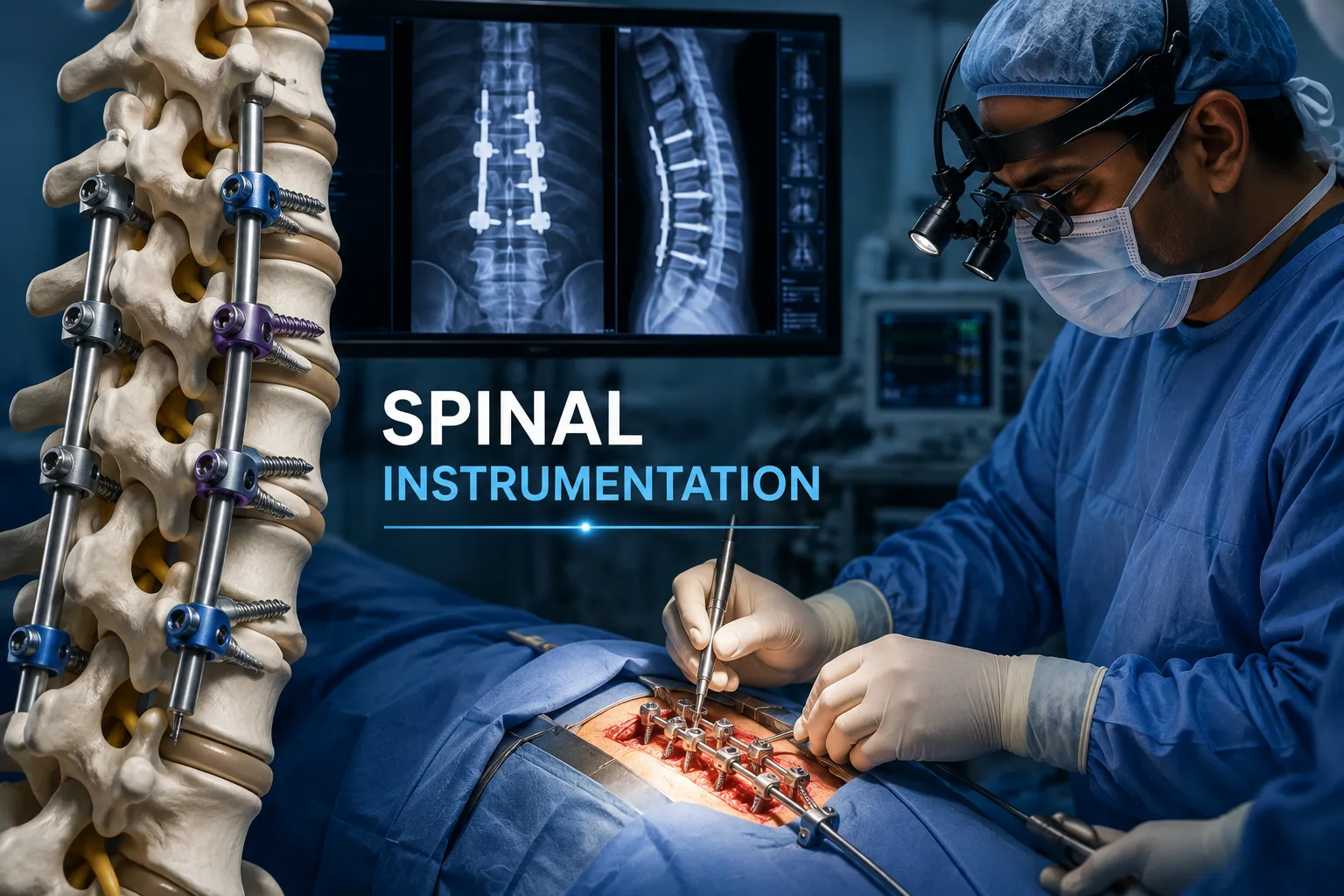
What Is Spinal Instrumentation?
Spinal Instrumentation is the surgical implantation of specific medical instruments such as rods, screws, plates, and cages for the purpose of stabilising the spine.
The specific implants used during Spinal Instrumentation are known as Spinal Implants, which are utilised to treat the instability of the spine, preserve its proper alignment, and stimulate bone healing, usually in conjunction with Spinal Fusion Surgery.
Modern day implants are made out of titanium, titanium alloys, or stainless steel to ensure their strength and durability, as well as compatibility with human tissue.
Spinal Instrumentation can be used in various diseases of the cervical, thoracic, or lumbar part of the spine. Dr. Arun Oommen performs procedures for spine stabilisation and surgical treatment of spinal instability and deformities.
When Is Spinal Instrumentation Needed?
The indication for Spinal Instrumentation is an unstable spine that cannot maintain its alignment and protect the spinal cord and nerves effectively.
Common indications for Spinal Instability Treatment include spinal fractures due to trauma, advanced degenerative disc disease, spondylolisthesis and other diseases that involve an abnormal slip of one vertebra over the other one.
Spinal Instrumentation is also indicated for treating various spinal deformities such as scoliosis and kyphosis, spinal tumours and infections, as well as revision surgery in cases when the initial spine surgery has been unsuccessful.
Often, Spinal Fusion Surgery is performed together with Spinal Instrumentation so that the bone heals and fuses into the correct and stable alignment position.
Types of Spinal Instrumentation Devices
There are several categories of Spinal Implants based on the section of the spine and underlying disease conditions.
- Rods and Screws (Pedicle Screw Fixation): The most widely used system for fixing the thoracic and lumbar spine through the connection of adjacent vertebrae.
- Plates: Widely used for the cervical spine in keeping the vertebral segments connected after the excision of discs or fractures.
- Interbody cages: These are implants placed between the vertebrae to ensure disc height and help in bone growth.
- Hooks and Braided Cables: These are used in selected cases of deformities and revisions requiring additional fixation.
The selection of Titanium Spinal Rods, screws, plates, or cages is based on the section of the spine and underlying conditions.
The Procedure: What to Expect
Prior to Spine Instrumentation Surgery, the patients have X rays, CT and MRI exams to locate the levels of the spine that need to be instrumented, and to define the exact position of the implants.
Spine Instrumentation Surgery is performed using general anesthesia. During surgery, the surgeon puts the chosen rods, screws, plates or cages into the spine to provide stability to the vertebrae that should not move any more, and bone graft material may be used to stimulate Spinal Fusion Surgery.
Modern operating theatres have intraoperative imaging systems, fluoroscopy and computer assisted navigational systems to increase the accuracy of Pedicle Screw Fixation and rod placement.
The duration of the Spine Instrumentation Surgery depends on the number of spinal levels and the complexity of the spinal problem.
Benefits of Spinal Instrumentation
Spinal Instrumentation makes an immediate stabilisation of the spine that is damaged, fractured or degenerated.
Providing stabilisation of abnormal movement can help to relieve patients of the pain caused by spinal instability or compression of nerves.
Combined with Spinal Fusion Surgery, instrumentation helps the healing process to take place in the right way and maintain the spinal alignment during fusion.
Properly selected patients can return to their normal life much earlier than without surgery. The modern titanium and titanium alloy implants are designed to last a lifetime.
Risks and Complications
Spinal Instrumentation is accompanied by several risks, just like every other complex spinal surgery.
These include general surgical risks such as infections, bleeding, blood clots, and issues with anaesthesia.
The specific risks associated with implants are implant loosening, misplaced screws, implant breakage, or failure, but these cases are relatively uncommon due to modern imaging and navigation techniques used today.
There is also the risk of nerve irritation, numbness, weakness, or damage during the implant placement.
The level of risks is variable depending on the patient’s age, bone condition, presence of other diseases, and the complexity of the spinal surgery and are discussed in detail in the preoperative consultations.
Recovery After Spinal Instrumentation Surgery
Spinal Instrumentation Recovery will depend on the scope of surgery and the patient’s overall health condition.
Most patients will be hospitalized for several days for post operative pain management, monitoring of the nerves, and assistance in early mobilization.
Early mobilization is usually recommended, and some patients will need a spinal brace in the first several weeks. Physiotherapy will be slowly introduced to help the patients with walking, posture, strengthening, and stretching.
If Spinal Fusion Surgery was done, then the fusion process will require several months to complete.
Follow up visits will include X ray or CT scan of the implanted material position and bone fusion process.
When Should You Consult a Spinal Instrumentation Surgeon?
Consultation with a Spinal Instrumentation Surgeon is recommended for patients who experience back or neck pain that does not respond to medical treatment or physical therapy, and imaging confirms the existence of spinal instability, fracture, spondylolisthesis, or spinal deformity.
Symptoms like weakness, numbness, gait disturbance, lack of balance, or urinary and faecal dysfunction associated with the spinal disorder also call for immediate specialist examination to decide which treatment is more suitable for you Spinal Instability Treatment or Spinal Fusion Surgery.
Frequently Asked Questions
Is Spinal Instrumentation permanent?
In most instances, Spinal Instrumentation is expected to be left inside the body permanently. Removal of the implants is generally done when there are any issues such as pain, loosening, infection, or any other complications.
Will I feel the metal implants in my spine?
Normally, most people will not be able to feel the implants since their body should have healed itself. Any pain or discomfort will be because of the surgery itself and the tissues around it.
How long before I can return to normal activity after Spine Instrumentation Surgery?
You can engage in light activities after a few weeks, but full /scale activities like working, exercising, or lifting heavy things can take several months.
Is Spinal Instrumentation the same as Spinal Fusion Surgery?
No. Spinal Instrumentation means the hardware used for stabilizing the spine while Spinal Fusion Surgery is the procedure through which two or more vertebrae fuse to form one solid bone segment. Both procedures are generally performed simultaneously.
Where can I get Spine Instrumentation Surgery in Kochi?
Spine instrumentation surgery is one of the surgical procedures performed in Kochi by Dr. Arun Oommen.