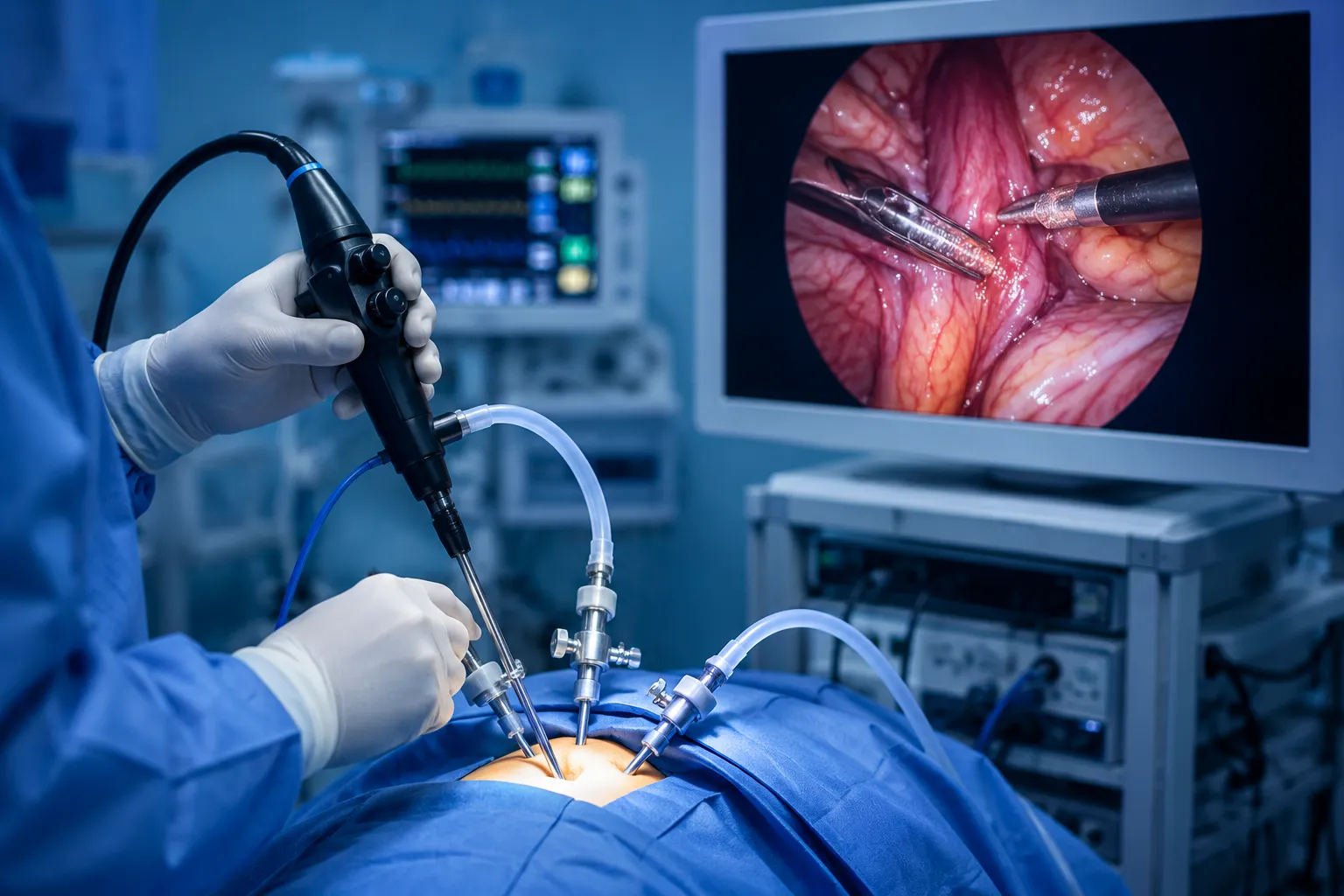
What Is Endoscopic Brain Surgery?
Endoscopic Brain Surgery, or Neuro endoscopy or Endonasal Endoscopy, is an advanced method of accessing some parts of the brain and base of the skull through the natural channels of the nose.
A special tube equipped with a high-resolution camera and tools is introduced via the nostril, providing the doctors with an opportunity to access deeper anatomical structures without any facial cuts on the head and without the need for cranial intervention.
Endoscopic Brain Surgery does not require cutting the scalp and removing bone when such an option exists, unlike a classical craniotomy operation. The operation is usually performed using the teamwork of neurosurgeons and otolaryngologists (ear, nose, and throat). This is explained by Dr. Arun Oommen, a neurosurgeon.
How the Procedure Works
1. Preoperative imaging: MRI and CT scans are done to locate the exact size, position, and nature of the tumour or lesion.
2. Insertion of the endoscope: A thin tube known as the endoscope is inserted into the nostril without having to create any external incision or remove skull bones.
3. Access to nasal cavity and sphenoid sinus: An ENT specialist creates the passage for surgery into the nasal cavity and sphenoid sinus, from where the skull base can be accessed safely.
4. Removal of the tumour or lesion: The neurosurgeon will then take on the intracranial aspect of the surgery and will remove the tumour or repair the damaged area by using special tools during the process of Endonasal Endoscopic Surgery.
5. Skull base repair: To seal the skull base, tissue grafts or synthetic materials are used.
6. Transfer to recovery: When the procedure ends and bleeding stops, the patient is transferred to the recovery area.
The above process is a usual one for Neuro Endoscopy for certain skull base and pituitary lesions.
Conditions Treated with This Technique
Endoscopic Pituitary Surgery is done mostly on patients with pituitary adenomas, which are tumours growing from the pituitary gland situated behind the nasal cavity.
Endoscopic Skull Base Surgery can also be employed in selected cases involving tumours of the skull base, including meningiomas and craniopharyngiomas, repair of CSF leaks, and anterior skull base defects.
In certain cases, Endoscopic Brain Tumour Removal can offer an approach to hard to reach lesions in the brain. This procedure cannot be applied to all patients. The criteria depend on the size of the tumour, its location, and the degree of spread, as shown on MRI or CT scans.
How It Compares to Traditional Open Surgery
Minimally Invasive Brain Surgery and traditional open craniotomy differ in several important ways.
| Feature | Endoscopic Brain Surgery | Traditional Open Surgery |
|---|---|---|
| Incision | No external incision; access through the nostril | Requires a scalp incision and opening of the skull |
| Recovery | Often associated with a shorter hospital stay | Usually involves a longer recovery period |
| Scarring | No visible external scar | Visible scar on the scalp |
| Visualization | High definition endoscopic view can improve access to deep skull base areas | Direct microscopic view; access may be more limited for some deep structures |
| Suitability | Best for selected pituitary and skull base lesions | Necessary for many tumours that cannot be safely reached endoscopically |
While Minimally Invasive Brain Surgery is beneficial in some instances, an open procedure will be necessary in many tumours and their locations.
The Surgical Approach and Technology Involved
Endoscopic Brain Surgery is generally done via a two surgeon technique. One ENT specialist deals with the nasal and sphenoid part of the procedure, while the other Endoscopic Neurosurgeon removes the tumour or repairs the skull base.
Operating rooms have neuro navigation, which works similarly to GPS surgery using pre operative imaging and intraoperative monitoring to ensure that nerves and blood vessels are not injured during the process.
Neuro Endoscopy requires special fellowship training in neuroendoscopy and skull base surgery due to the need to operate through tiny anatomical corridors close to critical parts of the brain.
Recovery After Endoscopic Brain Surgery
The recovery period of Endoscopic Brain Surgery Recovery is relatively quick compared to open craniotomy, as there is no large scalp incision and opening of the skull.
The patient stays in the hospital for a few days for neurological observation and pain management. Fluid balance is also monitored, particularly for Endoscopic Pituitary Surgery.
As there is no external wound, wound care of the scalp is unnecessary. Patients receive instructions for nasal care, saline washes, and limited activities for one or two weeks.
The follow up visit usually involves an MRI scan, while those who have pituitary disorders require pituitary function blood testing post operation.
Risks and Limitations
Despite its minimally invasive nature, Endoscopic Brain Surgery presents various risks.
These risks can range from cerebrospinal fluid leakage, infections, bleeding, damage to nerves and blood vessels near the surgical site, to hormonal imbalance when performing pituitary surgery.
In some instances, tumours may not be removed using the Endoscopic technique due to tumour size and/or proximity to brain structures.
Each patient has different levels of risk associated with this procedure, which are subject to discussion with a neurosurgery expert.
Frequently Asked Questions
How long is the hospital stay for Endoscopic Pituitary Surgery?
On average, it takes two to five days to recover from the procedure in the hospital, subject to the patient’s recovery, hormonal state, and presence of complications.
Does Endoscopic Brain Surgery leave a visible scar?
No. This type of surgery is conducted via the nostril; thus, it causes no visible scars on the face or the head.
Is Endoscopic Brain Surgery as effective as open brain surgery?
In case of properly selected pituitary and skull base pathology, Endoscopic Brain Surgery may achieve the same results as open surgery; however, its efficiency may vary according to the particular pathology that needs treatment.
Who performs Endoscopic Brain Surgery — an ENT surgeon or a neurosurgeon?
This surgery is often carried out together by an ENT surgeon and a neurosurgeon, where both of them deal with various aspects of the surgery separately.