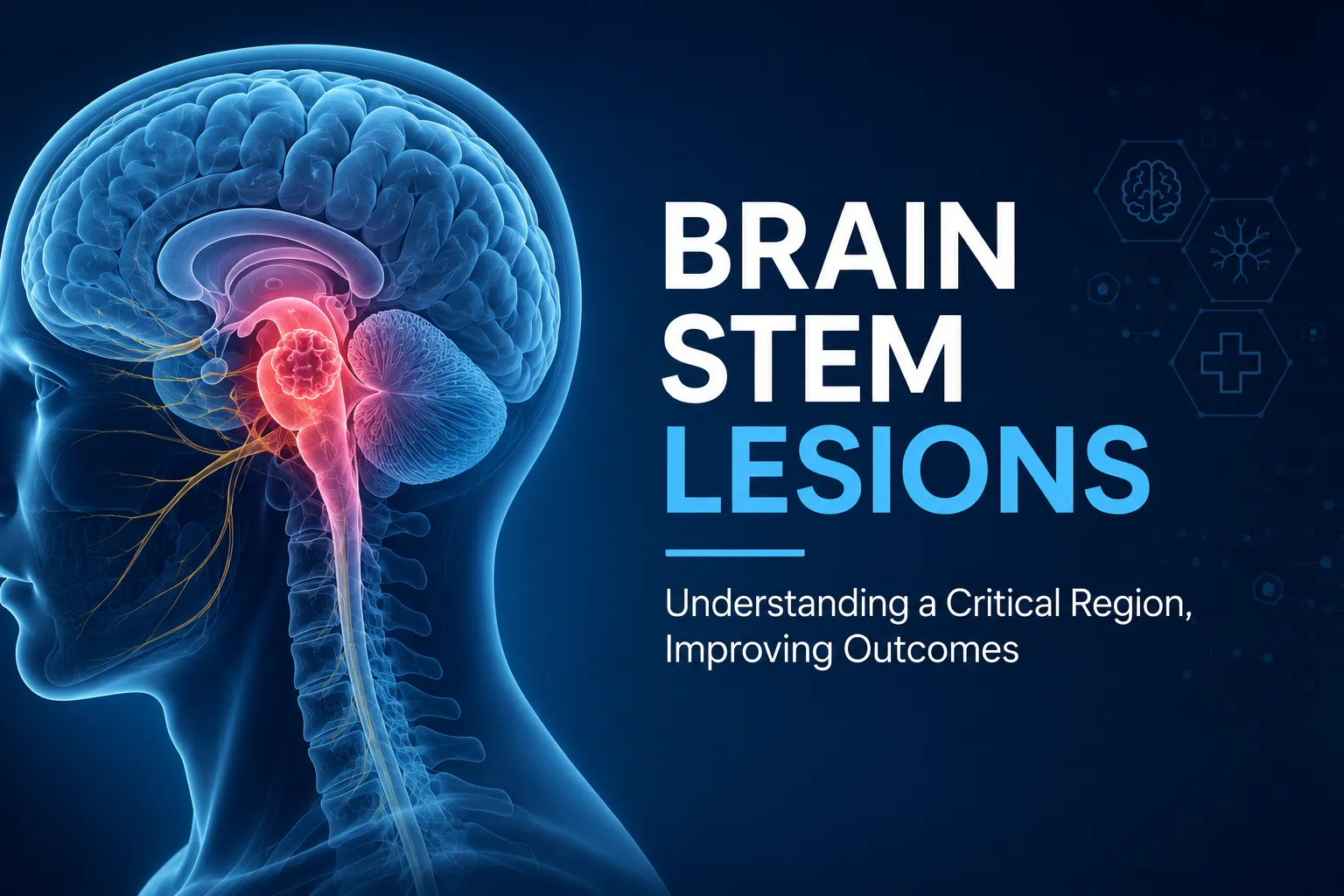
Understanding Brain Stem Lesions
A brain stem lesion is a region where the brain stem tissue shows damage or abnormalities.
The brain stem is the part of the brain that is responsible for controlling breathing, heart rate, consciousness, movements, and sensation. Given that the brain stem is the link between the brain and the spinal cord, the impact of lesions within it can be multiple and much more critical than those from lesions of other brain parts. The brain stem is made up of three sections: the midbrain, pons, and medulla, all vital to survival. Early detection and professional treatment can make a great difference. Dr. Arun Oommen, a neurosurgeon from Kerala, assesses and treats brain stem lesions.
What Are Brain Stem Lesions?
Brain stem lesions result from various neurological diseases and have the potential to disrupt vital bodily activities since the brain stem is responsible for regulating numerous automatic and life-preserving activities.
Points of note
- Conditions that cause brain stem lesions: Stroke, tumours, multiple sclerosis, infections, inflammation, trauma, and many more neurological diseases.
- Body functions impacted by brain stem lesions: Breathing, heart rate, swallowing, speaking, eye movement, coordination, and balance.
- Presentation: Lesions can either be focal (affecting a small portion of brain tissue) or diffuse (affecting a large portion of brain tissue).
Common types include:
- Demyelinating lesions (such as those seen in multiple sclerosis)
- Vascular lesions (including stroke-related abnormalities)
- Brain stem tumours
- Infectious or inflammatory lesions
Symptoms of Brain Stem Lesions
Brain stem symptoms are often distinctive because the brain stem contains vital cranial nerves and control centres.
Common symptoms include:
- Double vision
- Facial numbness or weakness
- Difficulty swallowing
- Slurred speech
- Vertigo, balance, or coordination problems
- Weakness or paralysis of an arm or leg
- Breathing difficulties or irregular heart rate in severe cases
Symptoms may appear gradually and can be mistaken for inner ear disorders, stroke, or other neurological conditions. Because these signs may indicate involvement of critical brain stem pathways, prompt evaluation by a neurological specialist is essential for accurate diagnosis and treatment.
Causes of Brain Stem Lesions
A brain stem lesion can be due to different conditions. These include stroke of the brain stem, cavernous malformations (cavernoma), and arteriovenous malformations (AVM).
Brainstem stroke disrupts blood flow, while cavernomas and AVMs cause bleeding within the brainstem. Brainstem tumours may be infiltrating brainstem structures, compressing them, or invading them. Demyelination, especially multiple sclerosis, may give rise to brain stem lesions in the form of plaques. Brain abscess, encephalitis, or other inflammatory conditions may also be a source of brainstem lesions. Sometimes, a brainstem lesion may occur after a head trauma, causing a traumatic brainstem lesion.
How Brain Stem Lesions Are Diagnosed
Brain stem diagnosis starts with a neurological examination involving a thorough neurological assessment, including examination of cranial nerves, reflexes, muscle strength, sensation, coordination, and balance.
The main test in diagnosing brain stem lesions is magnetic resonance imaging (MRI) of the brain stem, since it shows details of this intricate part of the nervous system. Contrast-enhancing brainstem MRI can be especially helpful when trying to establish whether there is a tumor or inflammation in the brain stem.
Based on the possible underlying condition, the doctor may recommend conducting MR spectroscopy, cerebral angiography, or lumbar puncture. It is necessary to define the precise cause of the lesion to make the correct treatment decision.
Treatment Options for Brain Stem Lesions
Brain Stem Treatment is dependent on a number of factors, including lesion size, behavior, type, location, and whether there are symptoms.
A small, stable, or asymptomatic lesion could be managed through close monitoring and regular MRI follow up scans. Medical management will include steroids to treat inflammation, disease-modifying treatment for MS-related lesions, and other drugs as appropriate.
Some tumors and vascular malformations might be amenable to treatment by Gamma Knife and stereotactic radiosurgery, where concentrated radiation is directed to the lesion without injuring surrounding tissues.
Management of brain stem lesions generally follows a multidisciplinary approach.
Brain Stem Surgery — What Patients Should Know
Indications for brainstem surgery include neurological deficit, mass effect, recurrent bleed, or when there is a need for biopsy to confirm the diagnosis. The brainstem controls important functions like breathing, swallowing, movement, and consciousness; hence, surgery needs extreme accuracy.
Points to remember:
- Indications: Neurological deficit, mass effect, recurrent bleed, or diagnostic biopsy.
- Latest techniques used: Neuro navigational technique, intra operative neurophysiological monitoring, and minimal access or endoscopic approach if appropriate.
- Aims: Maximum safe resection and preservation of vital neural pathways.
For patients planning brain stem surgery, Dr. Arun Oommen manages complicated brain and skull base neurosurgery cases depending on the lesion and the neurological state of the patient.
Recovery After Brain Stem Lesion Treatment
Brain stem recovery greatly differs based on the nature of the lesion, size, and location of the lesion as well as the procedure that was done.
The patient is usually observed in the hospital after undergoing surgery to monitor neurological functions, breathing, swallowing, and movement of the body. Some of the patients may be advised to undergo physical therapy to strengthen muscles and maintain balance, speech therapy to help them communicate, and swallowing therapy if they have issues with swallowing.
Repeat MRI is also vital in assessing the healing process as well as progression or recurrence of the condition.
When Should You Consult a Brain Stem Neurosurgeon?
If you suffer from persistent double vision, slurred speech, trouble swallowing, weakness of the face for no apparent reason, or numbness in half of the body, it is recommended that you consult with a brain stem neurosurgeon.
Balance issues, vertigo, and decreased coordination must all be checked out by a neurologist, particularly if there is progressive disease.
If your MRI report mentions some sort of problem in the brain stem, it needs to be examined by a competent neurosurgeon, regardless of how mild your symptoms are. Patients looking for brain stem lesions treatment in Kerala can benefit immensely from such consultations.
Frequently Asked Questions
Is a brain stem lesion always cancerous?
No, most brain stem lesions are a result of stroke, multiple sclerosis, inflammation, infections, or benign vascular malformations and do not arise from cancer.
What is the outlook for brain stem tumours?
It varies according to the type of tumour, its grade, position, and its reaction to treatment. Certain low grade tumours may stay stable for a number of years.
Is brain stem surgery safe?
Brain stem surgery is a very specialised operation; however, due to modern technology, neuro navigation, and intraoperative monitoring, there has been tremendous improvement in surgical safety and accuracy.
How long does recovery take after brain stem surgery?
It could take from a few weeks to even a few months, based on the intricacy of the brain stem lesion and the rehabilitation needed post surgery.
Where can I get brain stem lesion treatment in Kerala?
Brain stem lesion treatment is available in Kerala, including evaluation and management by Dr. Arun Oommen in Kochi.